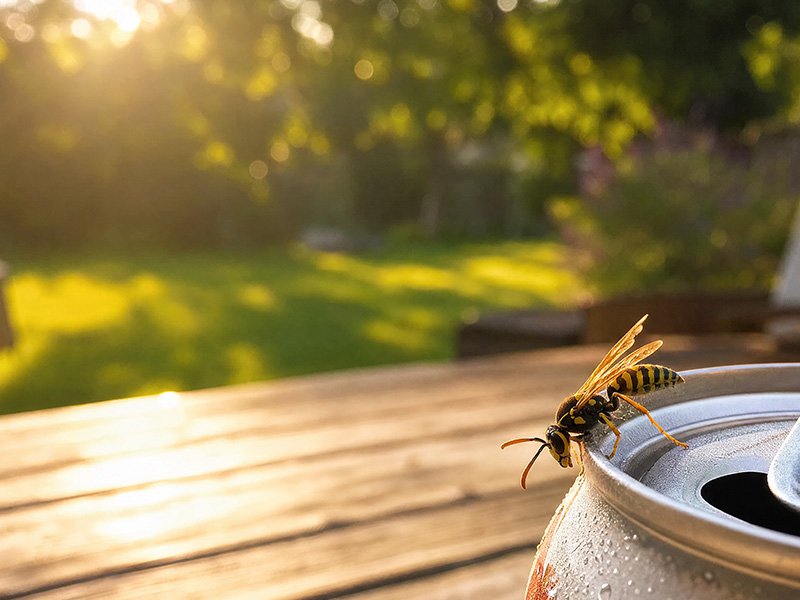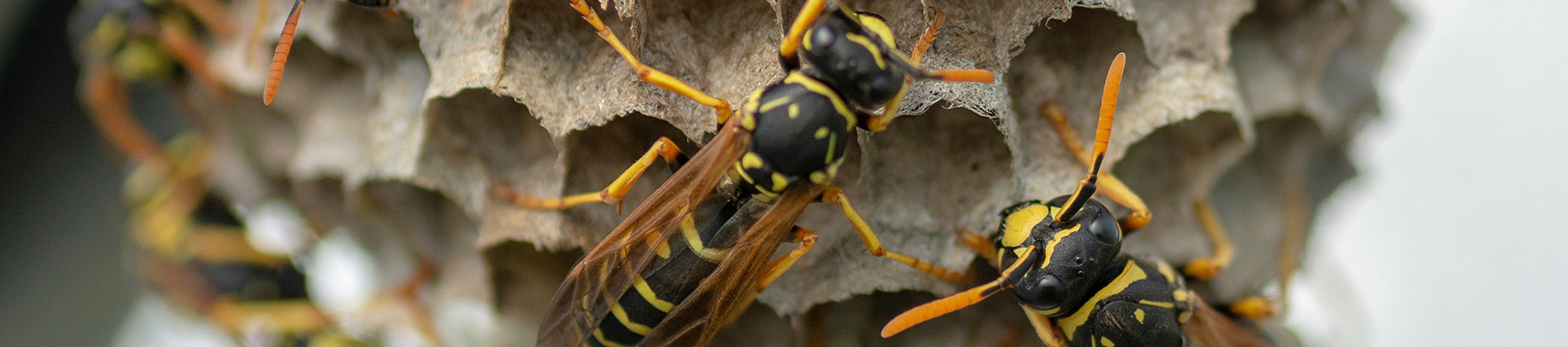
Paper wasps have slender bodies with long legs that dangle beneath them when they fly. They are typically black or dark brown with bold yellow markings and a narrow, elongated body. Workers are usually about ¾ to 1 inch long, making them slightly larger and more slender than yellow jackets. Their long legs, narrow waist, and more graceful appearance help distinguish them from the stockier yellow jacket.

Paper wasps become active in the spring when overwintered queens emerge and begin building new nests. In Northern California, this often starts in March or April as temperatures begin to warm.
Colonies grow throughout the summer, with activity peaking from late spring through early fall. Homeowners in Sacramento, Chico, Redding, and elsewhere in Northern California commonly notice increased paper wasp activity around porches, patios, sheds, and roof overhangs during the hottest months of the year.
By late fall, new queens leave the nest to find sheltered overwintering spots, and the rest of the colony dies off. Unlike yellow jackets, paper wasp colonies do not reuse old nests the following year.
Paper wasps are longer and more slender, with a noticeably narrow waist and long legs that hang visibly during flight. Their bodies are often marked with bright yellow and black coloration, but they appear less compact and more elongated than yellow jackets.
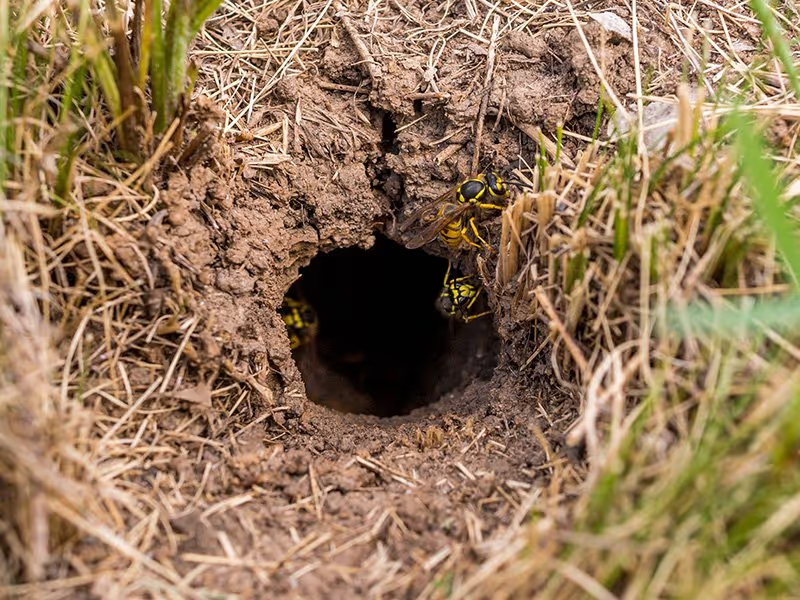
Their nests are also very different. Paper wasps build small, open-faced nests that look like an upside-down umbrella with visible honeycomb cells. Yellow jackets build enclosed nests, often hidden in wall voids, underground burrows, or other concealed spaces. If you can see exposed cells on the nest, you're likely looking at paper wasps.
Paper wasps are generally less aggressive than yellow jackets and bald-faced hornets, but they will sting to defend their nest. They tend to leave people alone unless they feel threatened—usually when someone gets too close to the nest, bumps into it, or disturbs the area around it. Because their nests are often built in high-traffic spots like doorways, porch ceilings, and eaves, accidental encounters are common.
Yes. Unlike bees, paper wasps have smooth stingers and can sting multiple times. A paper wasp sting is painful and can cause swelling and redness around the sting site. For individuals with venom allergies, stings can trigger more serious reactions that may require immediate medical attention.
Paper wasps prefer sheltered, elevated spots to build their open-comb nests. Common nesting locations include:
Because they favor areas with overhead protection, paper wasp nests are often found right next to doors, walkways, patios, and outdoor living spaces—exactly where homeowners and their families spend the most time. This is one of the most common reasons we receive calls for wasp control throughout Northern California during the spring and summer months.
Unlike termites, carpenter ants, or other wood-damaging pests, paper wasps don't cause structural damage to homes. They build their nests from chewed wood fibers mixed with saliva, creating a paper-like material that attaches to exterior surfaces.
While the nest itself won't damage your home, nests attached to painted or finished surfaces can sometimes leave staining or residue behind when removed. The bigger concern for most homeowners is the risk of stings, especially when nests are built near entryways, patios, play areas, or other high-traffic parts of the property.
Paper wasps are attracted to properties that provide safe, sheltered places to build nests. Covered structures that protect the nest from rain, wind, and direct sunlight are especially appealing.
Common attractants include:
Paper wasps are also beneficial predators that feed on caterpillars, beetle larvae, and other insects. While that can be helpful in a garden, it becomes a problem when a colony decides to build its nest next to your front door or outdoor seating area.
If you spot a paper wasp nest on your property, keep your distance and avoid disturbing it. Even though paper wasps are less aggressive than some other stinging insects, they will defend the nest if they feel it's being threatened. Swatting at them or trying to knock the nest down with a broom or stick can provoke a defensive response and lead to stings.
It's best to leave nest removal to professionals, especially when the nest is near a doorway, window, or outdoor seating area.
No. Paper wasps do not reuse old nests from previous seasons. At the end of the year, the colony dies off, and only newly mated queens survive the winter.
However, new queens often look for the same types of sheltered locations when building nests in the spring. That's why homeowners sometimes see new paper wasp nests appear in the same area year after year, even though the original nest isn't being reused.
Professional nest removal is the most effective approach. Trying to handle paper wasps yourself—whether with store-bought sprays or by knocking down the nest—can increase the risk of stings and may not fully address the problem.
Simply removing the visible nest doesn't always prevent future nesting activity. If the queen survives or other queens find the same protected location attractive, paper wasps may return to the area in future seasons.
Big Time Pest Control's experienced technicians use the proper equipment and techniques to remove paper wasp nests and treat the area to discourage future nesting activity. Contact us for fast, effective service.
You can reduce the chances of paper wasps setting up near your home by addressing the things that attract them:
Combining these prevention steps with ongoing professional pest protection gives you the best defense against paper wasps and other stinging insects. Big Time Pest Control's Guardian Plans include wasp nest removal, so if paper wasps decide to build near your home between scheduled visits, we'll take care of it. Contact us today to learn more about protecting your Northern California home.
Paper wasps are most active during the day. At night, they typically remain on or near the nest and are much less active.
Yes. Paper wasps occasionally enter through open doors, damaged screens, or small gaps around windows and vents. A wasp indoors usually doesn't indicate an infestation, but it may suggest a nest nearby.
Even a small nest can grow throughout the summer as the colony expands. Nests located near entrances, walkways, or outdoor living spaces can increase the risk of accidental stings.
Most paper wasp nests last for a single season. The colony dies off in the fall, and the abandoned nest remains inactive unless it is removed or damaged by weather.

Martin is an asset to your company! He’s very friendly and thorough and very helpful with any questions or concerns that we might have. I am very satisfied with the service he provides. Thank you to Martin and Big Time!!!!
Wayne L.
Anderson, CA

Jamie from Big Time Pest Control is the "BEST!" He calls to let me know he is on his way. He listens to any bug/rodent concerns I have, then does a very thorough treatment of my entire property! Thank you Jamie and Big Time for training your team in such a thorough manner!
Cindy Lou B.
Anderson, CA

Matt is always very thorough and willing to answer questions. He’s also the first person our dog is willing to take treats from. My dog likes you, and you get rid of my ants—that’s a win-win in my book. Thanks, Matt!
Danielle C.
Mt. Shasta, CA


Helpful Tips & Info