Harvestmen are recognizable by their compact, rounded bodies and long, thin legs. Unlike true spiders, which have two distinct main body regions connected by a narrow waist, the main body regions of a harvestman are broadly joined and can look like one oval body.
Most of the harvestmen people recognize as daddy longlegs have two eyes positioned on a small raised area near the top of the body. They have eight legs, with the second pair typically longer and used extensively to sense their surroundings.
Harvestmen vary in size by species, but the body is usually quite small compared with the legs. Many familiar long-legged harvestmen have bodies only a fraction of an inch long, while their extended legs make them appear much larger.
Color varies by species, but harvestmen found in California can be brown, gray, tan, or darker in color, sometimes with lighter markings.
Harvestmen become more noticeable as Northern California warms up, with activity generally increasing through spring and early summer and reaching its highest levels from July through September. By October, activity typically begins to taper off, with the lowest levels expected from November through March. This is a general seasonal guide, since local temperature, moisture, elevation, irrigation, and available shelter can influence when harvestmen are active around a property.
Harvestmen occur in California and are primarily outdoor arachnids. Around Northern California homes, they are most likely to be found in protected areas with moisture and organic material, including:
Because harvestmen are vulnerable to moisture loss, they are generally more comfortable in shaded or protected locations than on exposed, hot, dry surfaces.
No. Harvestmen belong to the arachnid order Opiliones, while true spiders belong to the order Araneae.
One of the easiest differences to see is body shape. A spider has two clearly defined main body regions, while a harvestman's body appears much more compact and oval because its main regions are broadly joined.
Harvestmen also do not have silk glands, so they cannot make webs. They do not have the venom glands spiders use to subdue prey.
That last difference also puts an old daddy-longlegs myth to rest: harvestmen are not highly venomous creatures whose fangs are simply too short to bite people. They do not produce venom.
Harvestmen eat a varied diet that can include small insects and other arthropods, dead organic material, fungi, and some plant material.
That makes harvestmen beneficial outdoors. They are part of the natural community of predators and scavengers found in yards, gardens, and other landscaped areas and do not damage structures.
Harvestmen are not considered dangerous to people or pets. They do not have venom glands, do not sting, and are not known for biting people.
They also do not damage wood, fabrics, stored food, or other parts of a home.
For most homeowners, a harvestman outdoors is simply another harmless arachnid. They become a nuisance mainly when multiple harvestmen gather around a structure or wander into garages and other areas where they are unwanted.
No. Harvestmen cannot produce silk and do not build webs.
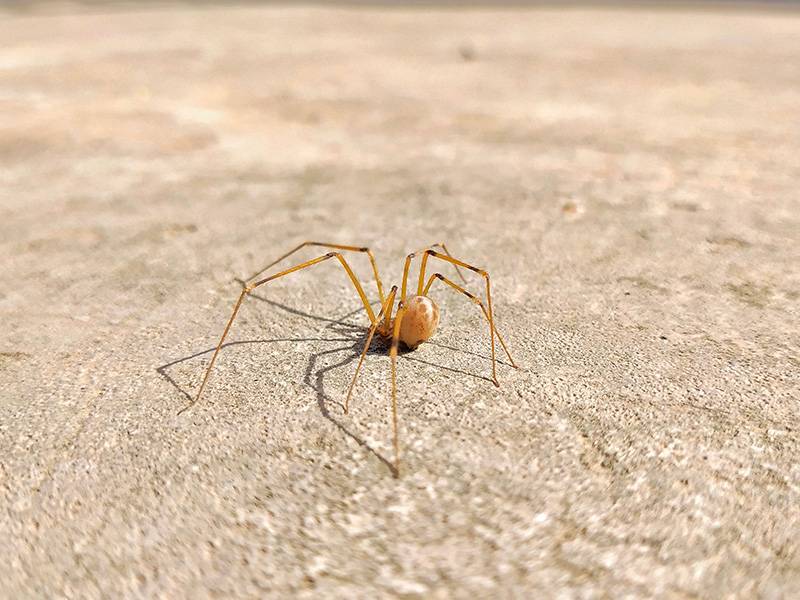
This is also a useful way to distinguish them from another long-legged arachnid found around California homes: the cellar spider.
Cellar spiders are true spiders. They have two distinct body regions and live in loose, irregular webs around garages, eaves, corners, and other protected areas. Because cellar spiders also have very long, thin legs, they are commonly called daddy longlegs even though they are not harvestmen.
If the long-legged creature you're looking at is sitting in a web, it is a spider rather than a harvestman.
Harvestmen are most likely to gather where they can find shelter, suitable moisture, and food. Conditions around a home that can make an area more favorable include:
Harvestmen sometimes gather together in groups in protected areas. Seeing several in one location does not mean they're nesting inside the home or that the structure is infested.
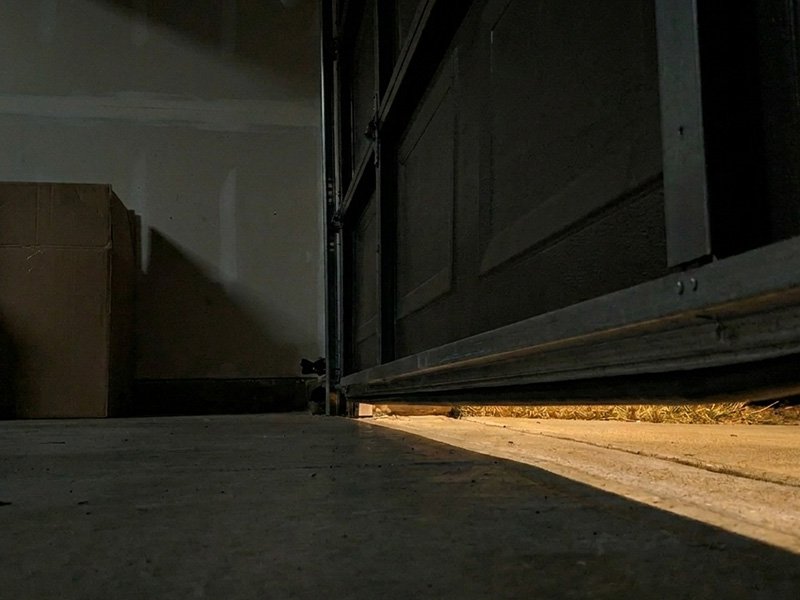
Harvestmen normally live outdoors. When one gets inside, it has typically wandered through an opening rather than established an indoor population.
Possible entry points include:
Because harvestmen need suitable moisture and shelter, those that wander into dry living areas usually do not survive or remain there for long.
An occasional harvestman outdoors generally does not require treatment. They are harmless and can be beneficial around landscapes.
If you're seeing large numbers around the house, start by looking at the conditions that are allowing them to gather. Excess moisture, dense vegetation, leaf litter, woodpiles, and other protected areas close to the structure can all provide favorable habitat.
It is also worth paying attention to what else you're seeing. Conditions that support harvestmen can support insects and other pests around the home's exterior as well.
If harvestmen are showing up alongside ants, spiders, cockroaches, earwigs, or other household pests, Big Time Pest Control can inspect the property and determine what is contributing to the activity around your home. Our residential pest control plans provide scheduled preventative service against 30+ covered household pests, with exterior treatments and interior service as needed.
You usually do not need to eliminate harvestmen from your property. Instead, focus on making the immediate area around the house less favorable to them.
Clear excess leaf litter and debris near the foundation, correct leaking faucets and drainage problems, avoid consistently wet conditions next to the house, move woodpiles away from the structure, trim vegetation back, and seal openings around doors, screens, utility lines, and other potential entry points.
If harvestmen are only an occasional visitor, those changes may be all that's needed. If you're also dealing with ants, spiders, cockroaches, rodents, or other household pests, Big Time's Guardian, Guardian Plus, and Guardian Pro plans offer year-round protection against covered pests with four scheduled preventative services each year.
Contact our local pest control team to find the right level of protection for your Northern California home.

Martin is an asset to your company! He’s very friendly and thorough and very helpful with any questions or concerns that we might have. I am very satisfied with the service he provides. Thank you to Martin and Big Time!!!!
Wayne L.
Anderson, CA

Jamie from Big Time Pest Control is the "BEST!" He calls to let me know he is on his way. He listens to any bug/rodent concerns I have, then does a very thorough treatment of my entire property! Thank you Jamie and Big Time for training your team in such a thorough manner!
Cindy Lou B.
Anderson, CA

Matt is always very thorough and willing to answer questions. He’s also the first person our dog is willing to take treats from. My dog likes you, and you get rid of my ants—that’s a win-win in my book. Thanks, Matt!
Danielle C.
Mt. Shasta, CA


Helpful Tips & Info